In B2B markets, technical product performance is the most common source of competitive advantage. In new or evolving applications, suppliers who deliver superior performance against step-change specifications win on merit rewarding the best technical solution with premium pricing.

    Over time, markets mature. Competitors close performance gaps and industry specifications converge. What once required technical leadership becomes table stakes (clean sheets!). When every supplier can meet the spec, purchase decisions shift to other criteria and pricing pressure intensifies.

    The disruptions of recent years have accelerated the shift to other, non-technical purchase criteria categories. Winter Storm Uri in 2021 shut down Gulf Coast chemical production for weeks, triggering cascading shortages across adhesives, coatings, and crop protection. COVID-19 exposed the fragility of single-source global supply chains. Wars in Ukraine and the Gulf have eliminated key chemical and raw material flows. Ongoing tariff volatility can change landed costs overnight. For B2B buyers who lived through supply failures, “will you be there when we need you?” has become as important as “does your product perform?”
    Question 1: Is Technical Performance Still Differentiating in Your Market?

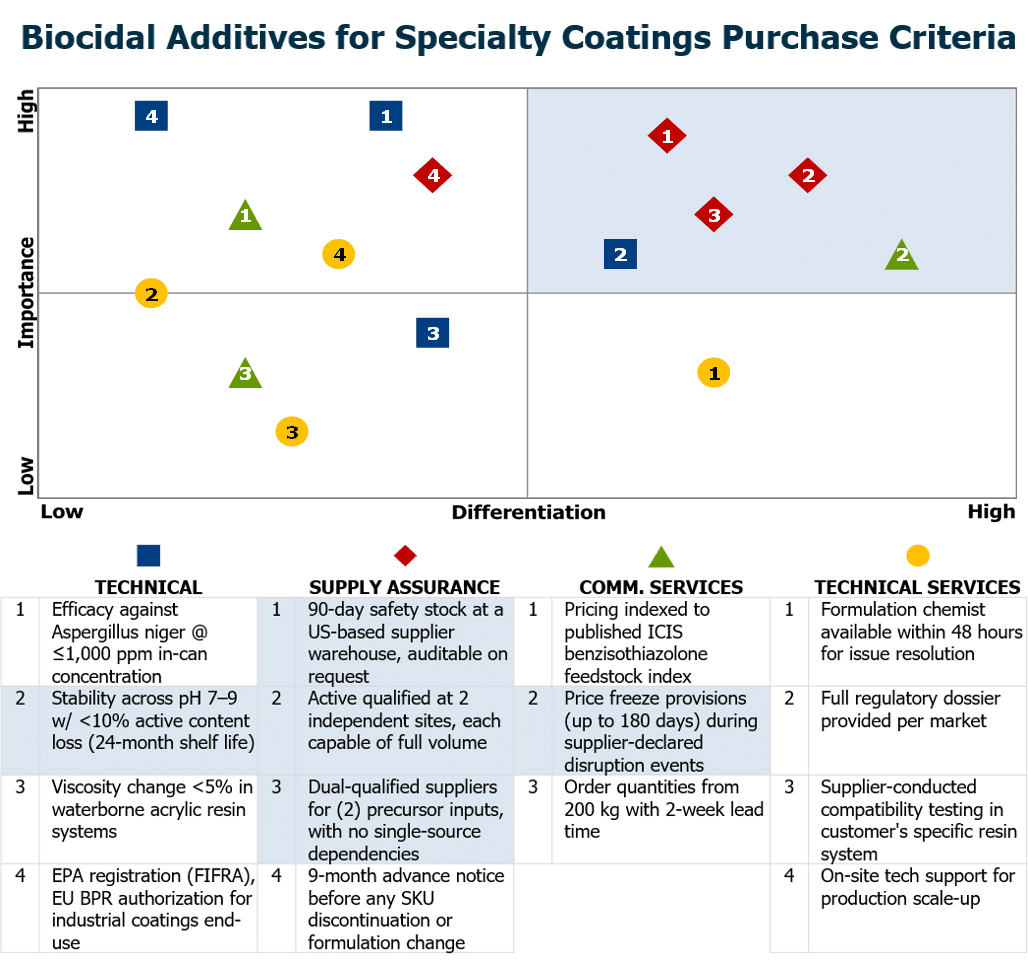
    In the redacted example above, three Supply Assurance criteria occupy the upper-right quadrant alongside one Technical and one Commercial Services criteria. Efficacy against the target mold and EPA Registration (classic technical differentiators in earlier market development) have migrated toward the upper-left, still important but no longer differentiating. Every credible supplier meets the specification. Without the Supply Assurance criteria, this example would be more commoditized and subject to significantly greater price competition.

    Question 2: Which Supply Assurance Criteria Do Your Customers Actually Prioritize?

    Not all supply assurance commitments carry equal weight. Customers who experienced the 2021 Texas freeze prioritize manufacturing redundancy. Those burned by pandemic-era single-source failures prioritize domestic inventory buffers and advance notification. Customers navigating tariff volatility prioritize price protection provisions and US-bonded inventory for imported actives. Disruption type drives priority.

    In the biocidal additives example, 90-day auditable safety stock at a US-based warehouse and active ingredient qualified at two independent manufacturing sites both rank high on importance and differentiation. Customers have moved beyond generic preferences for “reliable supply” to explicit, testable requirements.

    This specificity matters: a supplier committing to “90 days of inventory at a US-bonded warehouse, auditable on request” is making a fundamentally different offer than one claiming “we maintain safety stock.” The former is a verifiable competitive differentiator. The latter is a marketing claim.

    Question 3: Where Does Your Supply Assurance Position Create or Surrender Advantage?

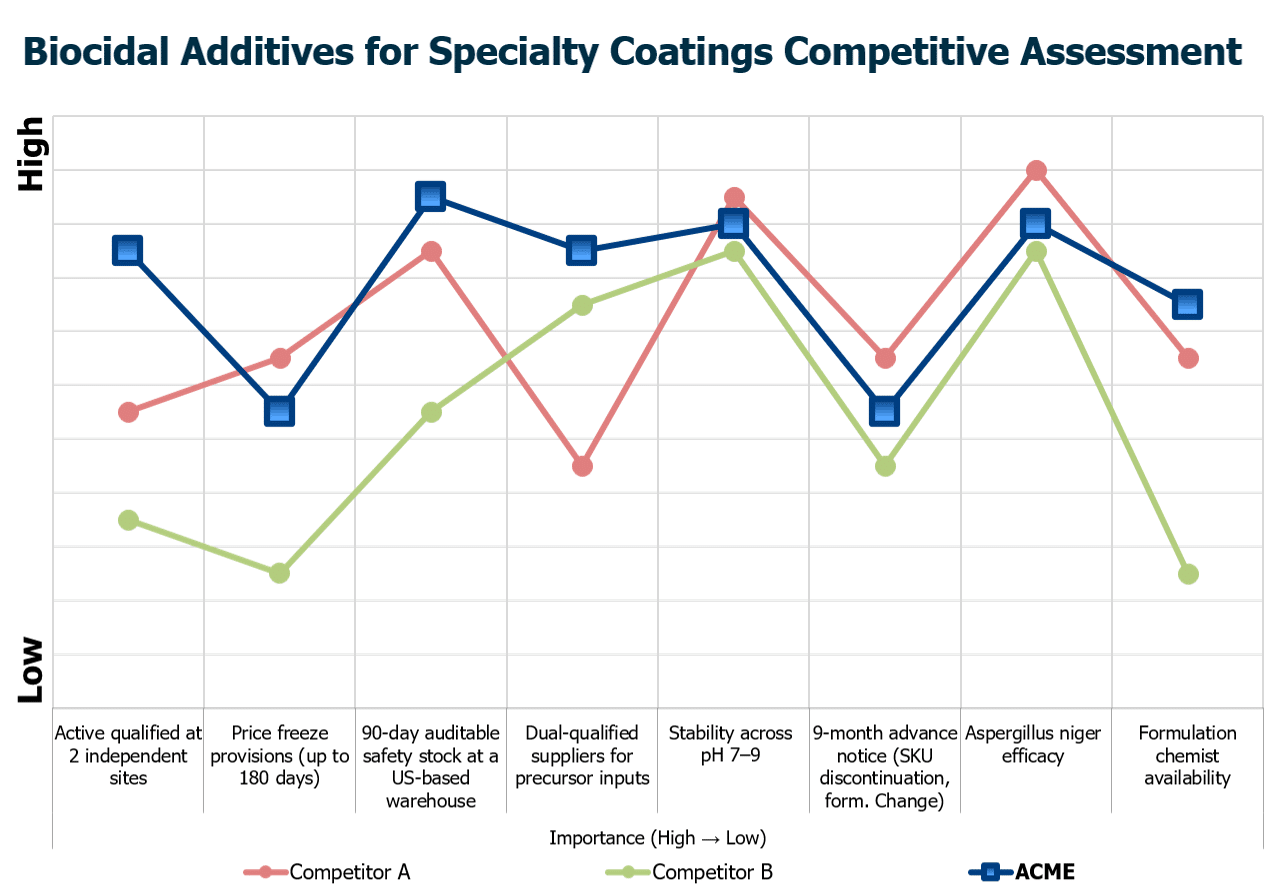
    Competitive Assessment maps supplier performance against the criteria that drive purchase decisions—revealing where you lead, where you trail, and where parity has emerged. Criteria are ordered on the x-axis by their position in the Purchase Criteria analysis—most important and differentiating first.

    In the example, ACME holds strong positions on multi-site qualification, 90-day auditable safety stock, and dual-qualified precursor inputs—the supply assurance criteria customers weight most heavily. Competitor B is notably weak across Supply Assurance, making its customer base vulnerable to a targeted supply assurance value proposition. However, ACME’s low scores on price freeze provisions and advance SKU discontinuation notice are real gaps on criteria customers prioritize. A complete supply assurance strategy requires closing those gaps, not only leading where investment has already been made.

    Practical Considerations

    1. Segment specificity matters. Supply assurance criteria vary significantly by industry. Regulatory pre-qualification is critical in crop protection and medical devices but largely irrelevant in bulk specialty chemicals.
    2. Proof beats promises. Supply assurance only functions as a purchase criterion when it is verifiable. Safety stock claims without auditable documentation or customer access are marketing, not differentiation.
    3. Disruption type drives priority. Pandemics stress manufacturing redundancy. Extreme weather stresses regional distribution. Tariff volatility stresses domestic inventory buffers. A supply assurance portfolio addresses multiple disruption scenarios simultaneously.
    4. Supply assurance has a cost—and a value. Customers who genuinely prioritize supply assurance should pay for it. Suppliers who provide it should price accordingly and quantify the value delivered.

    From Operational Commitment to Strategic Advantage

    Supply assurance is not a commodity commitment. Building auditable inventory reserves, qualifying alternate manufacturing sites, and securing dual-source raw material supply requires capital and organizational discipline. But for customers who have experienced supply failures, these investments directly address existential risks. Customers in that position are willing to pay for confidence.

    When technical performance parity is the market reality, supply assurance can become the basis for premium pricing, preferred supplier status, and long-term agreements. The suppliers who build this capability before the next disruption—not during it—earn both the loyalty and the margins their investment warrants.

    For more information about Market Edge tools and frameworks, or to discuss your competitive strategy, contact us at info@mkt-edge.com.

    Purchase Criteria and Competitive Assessment analyses generated with Market Edge Tools and Frameworks