In uncertain markets, pricing decisions become more difficult. Customers push for discounts. Sales teams request flexibility to close deals. Finance demands margin protection. When market visibility decreases, cost and target margin often become the anchor for pricing decisions, not because companies explicitly choose cost-plus pricing, but because quantifying customer value feels too uncertain.

    When pricing defaults to cost and margin rather than value delivered, you either leave significant money on the table in high-value applications or lose opportunities in segments where customers see less differentiation.

    Value-based pricing is challenging—it requires customer insight, competitive intelligence, and analytical rigor. Working through the frameworks builds the understanding and confidence needed to defend pricing decisions when market conditions make it tempting to discount. The following questions, supported by Market Edge Tools, develop value-based pricing strategies that capture fair value while remaining defensible.
    Question 1: What Economic Value Does Your Solution Create?
    Value pricing starts with quantifying the economic benefit your solution delivers from the customer’s perspective. This isn’t about your product’s features—it’s about the customer’s outcomes.

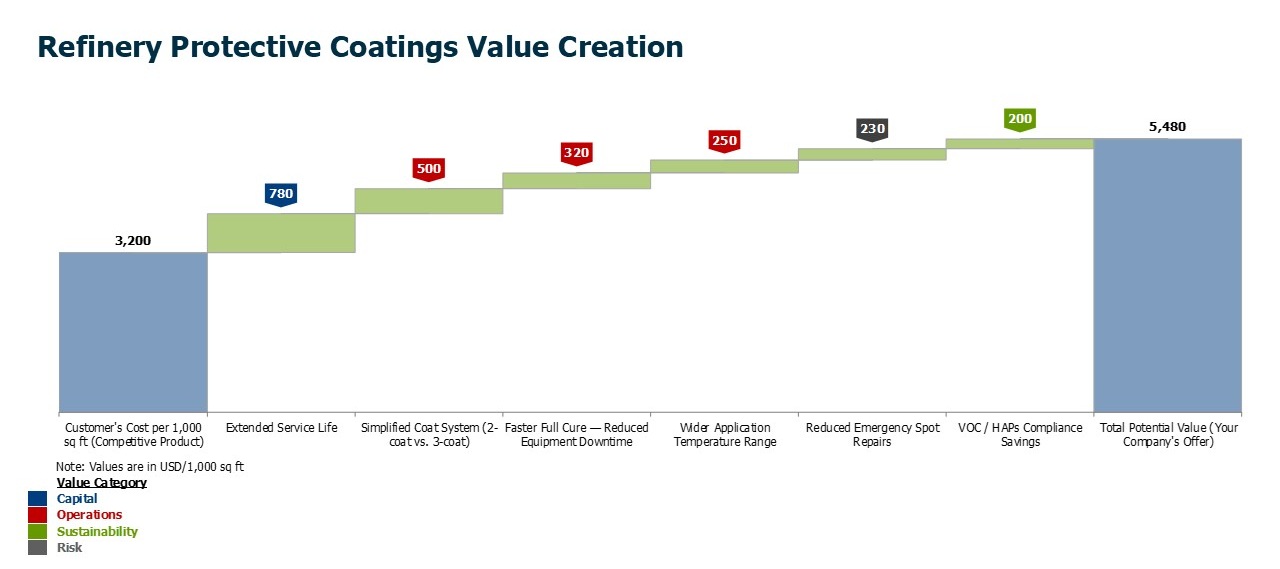
    Develop a Value Creation analysis that identifies and quantifies each element of value: revenue enhancement (increased yield, throughput, or sales volume), cost reduction (lower input costs, reduced waste, improved efficiency), risk mitigation (reduced variability, ensured compliance, prevented failures), and time savings (accelerated processes, reduced downtime, faster decisions).

    Each element should be quantified in the customer’s terms—dollars per area treated, cost per unit produced, hours saved per month. Generic claims about “better performance” don’t support pricing decisions. Specific, measurable value does.

    Critical insight: Value varies by customer and application. A high-performance 2-coat refinery coating delivering fast cure, superior chemical resistance, and a 12–15 year service life might create $2,000 per 1,000 sq ft of incremental value on process-critical vessels during a scheduled turnaround — where every day of extended downtime costs hundreds of thousands of dollars.

    That same coating creates far less incremental value on secondary structural steel with minimal chemical exposure and no downtime sensitivity. Your pricing strategy must reflect these differences, or you’ll systematically overprice routine maintenance applications while leaving significant margin on the table in high-consequence, turnaround-driven work.

    Question 2: How Do Customers Weigh Value Against Price?
    Understanding value creation is necessary but not sufficient. You must also understand how customers make purchase decisions – which criteria matter most and the tradeoff between performance, economics, and risk.

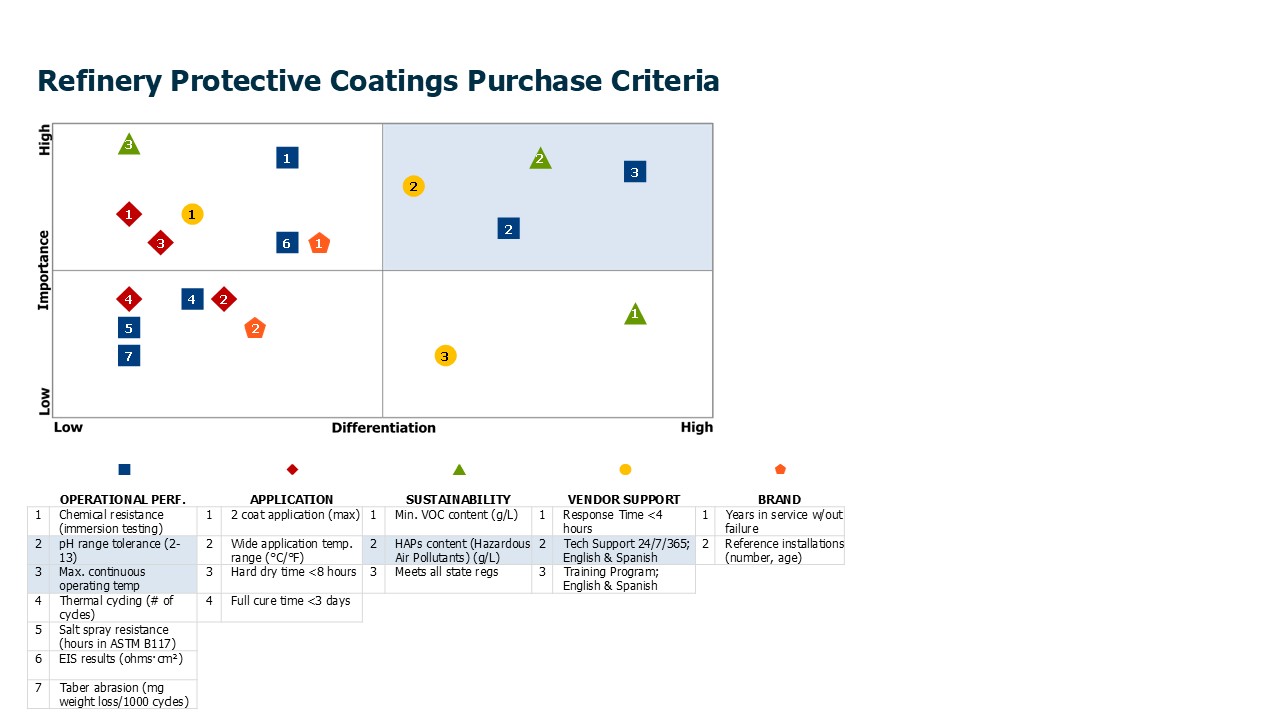
    Purchase Criteria analysis identifies what drives choice in your target segments. The analysis maps two perspectives: which criteria customers use to differentiate between suppliers, and the relative importance of each criterion.

    A criterion might be important (“we need reliable technical support”) without being differentiated (“all major suppliers provide it”). Premium pricing requires advantages on criteria that are both important and differentiating.

    Purchase Criteria

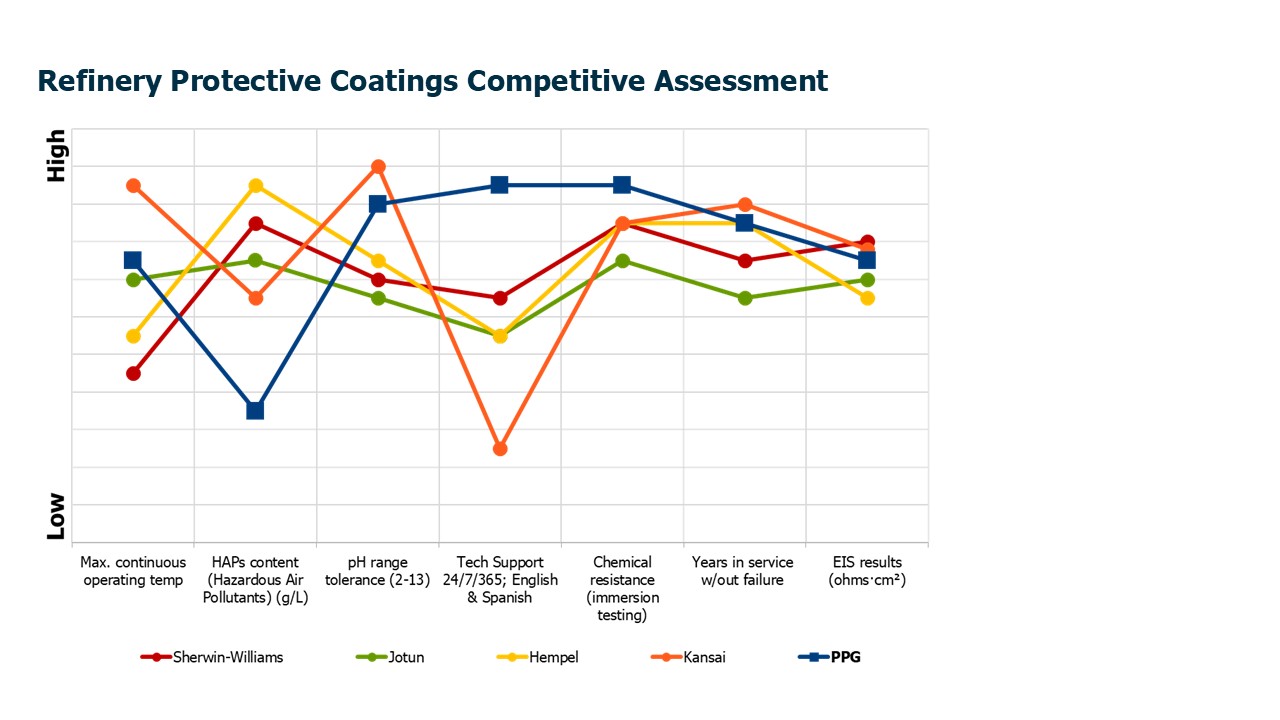
    Competitive Assessment characterizes your position on the criteria that drive choice. In specialty chemical markets, suppliers often invest heavily in technical service capabilities that customers value but don’t differentiate on—all credible suppliers provide comparable support. Meanwhile, delivery reliability or formulation flexibility might strongly differentiate but receive less investment.

    Competitive Assessment

    Question 3: What Price Captures Fair Value Without Triggering Competitive Response?

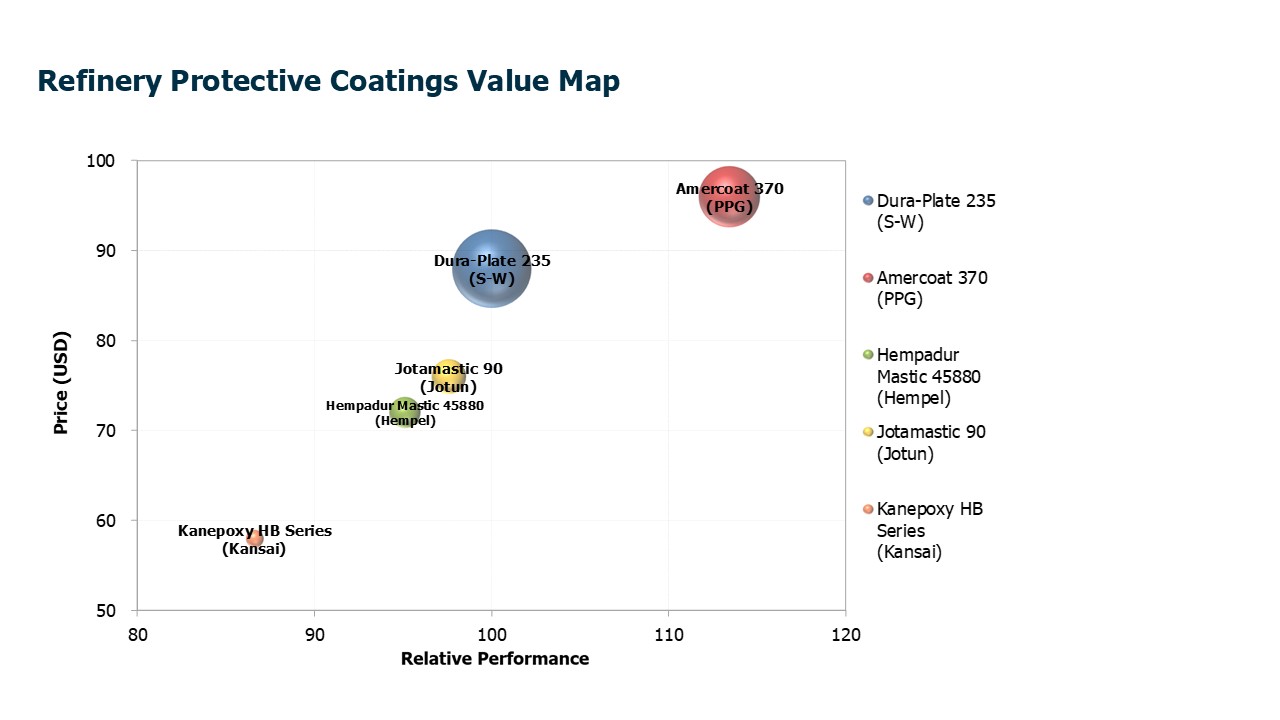
    Value Creation analysis tells you the ceiling—the maximum value customers receive. Value Pricing finds the realistic price given perceived performance and competitive behavior.

    The framework balances: perceived differentiation (how much better do customers view your solution on criteria that matter?), reference price points (what are customers paying for competitive alternatives?), and competitive dynamics (how will competitors respond to your pricing?).

    If your coating delivers $2,000/1,000 sq ft more value than a competitor system installed at $3,200/1,000 sq ft, a price of $4,800–5,000/1,000 sq ft captures fair value while remaining clearly justified. But if that premium triggers aggressive competitive discounting, you might be left with an unacceptably small share (albeit with strong gross margins).

    Building Pricing Confidence

    In uncertain markets, defaulting to cost-driven pricing feels safe. But it systematically underprices where you create superior value and overprices where you don’t—exactly the wrong outcome. Discounting trains customers to expect low prices and signals to competitors that you lack differentiation.

    Value-based pricing requires investment in market research, analysis, and execution discipline. When you can quantify the value you create, understand what drives customer choice, and assess competitive dynamics, you have the confidence to defend your pricing.

    For more information about Market Edge pricing tools and frameworks, or to discuss your pricing strategy, contact us at info@mkt-edge.com.