How to Build Commercial Excellence into the Operating Model
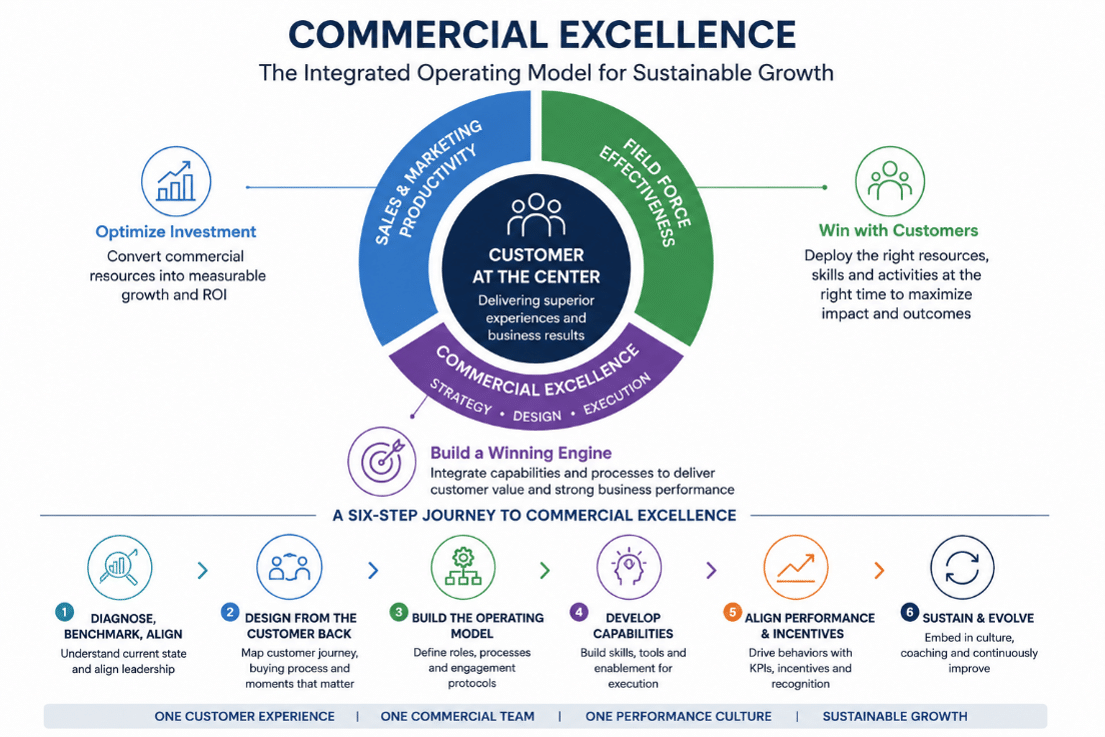
The Market Edge framework follows a six-stage approach that transforms strategy into execution.
1. Diagnose, Benchmark, and Align
The journey begins with establishing a fact-based understanding of the current state. This includes benchmarking capabilities, evaluating time allocation and customer engagement practices, assessing the operating model, and aligning leadership around future priorities.
2. Design from the Customer Back
Rather than designing around internal structures, leading organizations begin with customer needs. This stage focuses on understanding customer journeys, buying processes, influence networks, and critical moments that matter. Strategic commercial assets such as demand generation, technical support, channel enablement, account management, customer operations, and campaign execution are then aligned to these customer requirements.
3. Build the Commercial Operating Model
Strategy must be translated into an executable commercial engine. Organizations define the activities required to win in the market and convert those activities into clearly defined roles, responsibilities, engagement protocols, selling processes, and integrated planning mechanisms. The result is a simplified and scalable operating model that clarifies how sales, marketing, technical, customer operations, and support functions work together.
4. Develop Capabilities
Even the best operating model will fail without the skills and tools required for execution. Commercial excellence therefore includes targeted capability development, technology enablement, coaching, and practical learning experiences that improve individual and team performance.
5. Align Performance and Incentives
Performance management systems must reinforce desired behaviors. Organizations establish meaningful KPIs, performance tracking processes, incentive structures, and recognition programs that align employee actions with customer and business outcomes.
6. Sustain and Evolve
Commercial excellence becomes a competitive advantage only when it becomes part of the culture. Continuous coaching, benchmarking, capability evolution, onboarding, and talent development ensure the organization remains agile as customer expectations and market conditions continue to evolve.